Have You Ever Been Betrayed?
Yes! I have been betrayed I am not one to take things to heart but this certain someone actually hurt me. Like many other teenager I was betrayed by someone I actually cared about and regarded as one of my best friends within my entire secondary school life. I thought she and I was friends and was closer than to make petty teenage problems get between what we had established within a whole 4 years of school.
Give An Example Of When You Were Betrayed? How Did You Feel? What Did You Do?
In fifth form one of my best friends that I had came to form a bond with over the five years that I spent at Princess Margaret Secondary School decided it was ok to start a rumor within the school about me because of the strain placed on your relationship when she repeated fourth form. On account of her repeating fourth form I had no one to talk to in my classes so hence I started to develop a friendship with another young lady that I’ve become acquainted with throughout the years but never really talk to. This caused my best friend to become jealous because she thought I didn’t spend enough time with her. She was so sneaky and conniving that she made it sound like the friend I just made it up. I was dumbfounded, disappointed and high upset because I thought we were actually starting to become friends every time I saw her in class I wanted to curse her out but then I thought that would make her feel better because I was giving her the attention that she craved. So instead I ignored her and when she would save me a sit in class I would sit somewhere else and when called me I wouldn’t answer. I being naïve to the situation at hand went to tell my best friend about in and she consoled me.
Have you ever felt that you were betrayed and in the end misunderstood the situation?
While I thought that my new friend that I had met in my classes gad started the rumor because the person who told what people were saying to told me it was my friend I automatically amused it was my new friend because never thought that my best friend could do something like that to me. After sitting down and talking to my new found friend I explained her what the situation was she forgive me and we’re best friend today.
Look at the various Shakespeare plays over the years that you have studied. Do you notice that characters in the text always seem to resort to violence, trickery or evilness?
In all of Shakespeare’s play that I have studied throughout the year’s violence, trickery or evilness has been ever so evident within these plays. In Much Ado About Nothing trickery is used in the event when Borachio tricks Margaret into dressing up like Hero and going into Hero’s room and stand infront of her window her, which was done to illustrate the plan to deceive Claudio into thinking that Hero is being unfaithful. Trickery was also used in the play Much Ado About Nothing when news of Hero’s death spread and also seen when Claudio was fooled into to thinking her was marrying Antonio’s daughter but he was actually marrying Hero.
In ‘Merchant of Venice’ trickery is also shown when Portia fooled the entire court room when she disguised herself and Nerissa her waiting maid as men to defend Antonio in court against Shylock.
In ‘Romeo and Juliet’ trickery is also shown in the case where Friar Laurence helps Juliet to falsify her death in order for her to marry Romeo.
In’ Taming of the Threw’ trickery is seen Lucentio and Hortensio disguises themselves as a music tutors named Cambio and Litio to try to woo Bianca.
In ‘Julius Caesar’ trickery is seen in this book when Cassius wrote letters to Brutus in different handwritings over months in order to get Brutus to join the conspiracy and turn against Caesar
Violence is also evident in ‘Julius Caesar’ As Caesar, predictably, rejects the petition, Casca grazes Caesar in the back of his neck, and the others follow in stabbing him; Brutus was last.
Violence is also seen in ‘Macbeth’ when Macbeth murders Duncan and his wife Lady Macbeth frames Duncan's sleeping servants for the murder by placing bloody daggers on them, he also Macbeth murders the guards before they can protest their innocence and A battle culminates in the slaying of the young Siward and Macduff's confrontation with Macbeth beheads him.
In ‘Hamlet’ violence is evident when Hamlet stabs wildly through the cloth, killing Polonius.
Evilness is seen in ‘Merchant Of Venice’ is shown when Antonio insulted and spat on Shylock for being a Jew and it is also seen when Shylock demands a pound of Antonio’s flesh closes to his heart because he wanted revenge for what he has done to him.
Evilness is seen in ‘Hamlet’ is shown When he realises that he has killed Ophelia's father, he is not remorseful, but calls Polonius "Thou wretched, rash, intruding fool.” It is also seen in Claudius's murderous plot.
Look at the background of the text Winter's Tale. What is going on historically in the era that the book is written in.
The Winter's Tale is a play by William Shakespeare, originally published in the First Folio of 1623. Although it was grouped among the comedies, many things occurred historically in the era that the book was Written: 1589-1593 Published: 1623.Which is England was a weak and unstable nation. Torn by internal strife between Catholics and Protestants, an economy in tatters, and unstable leadership, England was vulnerable to invasion by her stronger rivals on the continent. By the time of Elizabeth's death in 1603, she had turned the weakling of Western Europe into a power of the first rank, poised to become the mightiest nation in the world. At the center of the play is a royal family separated by tragedy, and their miraculous reunification provides the play's happy ending. Prior to 1603, England had gone a long time without a full royal family: Elizabeth had been childless and unmarried, meaning that England had a majestic Virgin Queen who was worshipped and adored. But they had no full royal family that they could look to as a model for their own families, no central family to act as a symbolic microcosm for the larger family of the English nation. In 1603, James I ascended to the throne, and suddenly England had such a family.
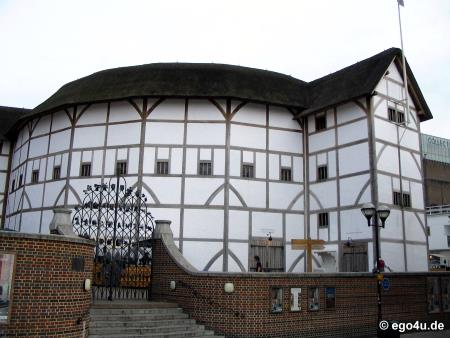
What is the Elizabethan theater? Historical back ground? Picture of the global theater

Prior to the reign of Elizabeth I, theatre companies made a living by travelling around the country looking for large audiences to perform. When Queen Elizabeth came to power and throughout her reign, she fostered the rise and formalization of English drama. It was during her era that drama began to be recognized as a complex art form to be appreciated, loved and critiqued by the masses. Queen Elizabeth’s own interest in drama led to this increasing interest.
When Shakespeare was twelve years old, an actor named James Burbage built London’s first theatre, called simply ‘The Theatre’, just beyond the city walls in Shoreditch. Actors- even prominent and well-to-do actors like Burbage- occupied a strange place in London society; they were frowned upon by the city fathers but were wildly popular with the common people.
In 1597, the city fathers closed down ‘The Theatre’. In late 1598, Richard Burbage (James’s son) and his men dismantled it and hauled it in pieces across the Thames to Southwark. It took them six months to rebuild it, and when they did they renamed it the ‘Globe’.
Critics dispute the exact shape and structure of this building however many believe it was round and octagonal. Shakespeare makes reference to the building in Henry V calling it “this wooden O”. It is believed that the design and structure of this building was derived from the beat-baiting and bull-baiting rings built in Southwark.
The building could seat in excess of 2500; but actors had to project their voices to be heard. Back then, there was no technology which is utilized in the theatre today. Sound effects, special lighting, scenery and all the modern amenities now used to enhance productions were entirely absent. The actors were forced to use their own abilities to compensate for the lack of technology.
In 1613 a cannon was fired as a part of a performance of Henry VIII set the theatre’s thatched roof on fire and destroyed it. The patrons escaped unharmed, but the Globe was completely destroyed.
Building a replica of Shakespeare’s Globe was American actor Sam Wanamaker’s dream. After long years of fund-raising construction, the theatre opened its doors full season on June 8, 1997.
Like the earlier Globe, this one was also made of wood, with a thatched rood and lime plaster covering the walls.
During the late 16th century, Elizabethan drama became fully- developed. Playwrights turned away from basing their plays on the religious aspects of society and began writing more sophisticated plays. Drawing on models from ancient Greece and Rome, writers introduced tragedies- plays in which disaster befalls the hero/heroine. Dramatists also began writing their plays in carefully construed of unrhymed verse, using fanciful language and making the words play a vivid image in the viewers minds.
There was no curtain that opened or closed at the beginning or end of plays. At the back of the stage, there was probably a wall with two or three doors leading to the dressing rooms of the actors. These rooms collectively were known as the "tiring house." To tire means to dress–that is, to attire oneself. Sometimes, the wall of the tiring house could stand as the wall of a fortress under siege. Props and backdrops were few. Sometimes a prop used for only one scene remained onstage for other scenes because it was too heavy or too awkward to remove. Peter Street was the carpenter/contractor hired to construct the Globe. The main rival of the Globe in the first years of the 17th Century was the Fortune Theatre, constructed in 1600 (also by Peter Street).
........In Shakespeare's time, males played all the characters, even Juliet, Cleopatra and Ophelia. Actors playing gods, ghosts, demons and other supernatural characters could pop up from the underworld through a trap door on the stage or descend to earth from heaven on a winch line from the ceiling. Off the stage, the ripple of a sheet of metal could create thunder. Stagehands set off fireworks to create omens, meteors, comets, or the wrath of the Almighty. Instruments such as oboes and cornets sometimes provided music. If an actor suffered a fencing wound, he simply slapped his hand against the pouch (perhaps a pig's bladder) beneath his shirt to release ripe red blood signaling his demise.
.......The gallery had a thatched roof. (Thatch consists of straw or dried stalks of plants such as reeds.) During a performance of Henry VIII on June 29, 1613, the Globe Theatre burned down after booming canon fire announcing the entrance of King Henry at Cardinal Wolsey's palace ignited the roof.
.......The gallery had a thatched roof. (Thatch consists of straw or dried stalks of plants such as reeds.) During a performance of Henry VIII on June 29, 1613, the Globe Theatre burned down after booming canon fire announcing the entrance of King Henry at Cardinal Wolsey's palace ignited the roof.


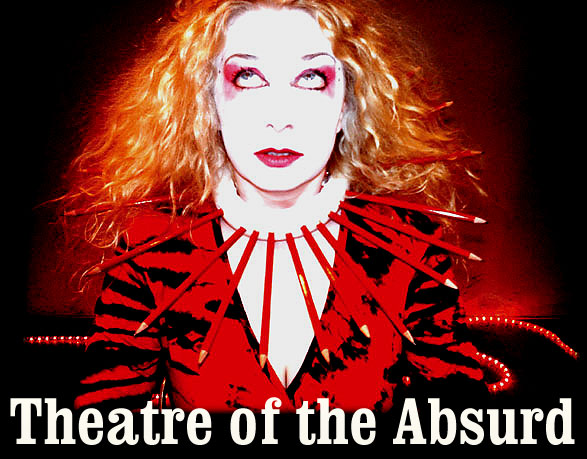 Theatre of the Absurd was a term used to refer to a set of plays written primarily in France from the mid-1940s through the 1950s. In these plays, the dramatists used illogical situations, unconventional dialogue and minimal plots to express the apparent absurdity of human existence. There existed no formal “absurdist movement” in the theatre. Dramatists whose works fell under the category had a pessimistic vision of humanity struggling vainly to find a purpose in life and to control its fate. The existential philosopher, Albert Camus, and other philosophers such as Jean-Paul Sartre used the term absurd to express their inability to find any rational explanation for human life. The dramatic works of certain European and American dramatists of the 1950s and 1960s have been referred to as the “Theatre of the Absurd”. This was so because they essentially subscribed to the theory proposed by Albert Camus, in his essay The Myth of Sisyphus. |
The works of well-known dramatists such as Samuel Beckett, Eugene Ionesco, Jean Genet, Arthur Adamov, Harold Pinter and a few others have been classified under the “Absurd” Theatre. A British scholar Martin Esslin, in his critical study of Samuel Beckett and French playwrights Eugène Ionesco, Jean Genet and Arthur Adamov, first used the term “Theatre of the Absurd”.
Since the ideas dictated the structure of the plays, such playwrights did away with logical structures such as those exist in conventional theatre. Dramatic action, as conventionally associated with theatre and plays is in small doses, although the players continue to perform. It is one way of conveying that whatever they did, nothing will change their existence or fate. For instance, there is no specific storyline or plot in Samuel Beckett’s Waiting for Godot.[KC1] The play revolves around two tramps, who are apparently lost and who are filling their days waiting for somebody called Godot. Who was Godot, when he would come and whether he would come at all are issues to which they have no answer. The absurdity of life and living is subtly brought out.
As mentioned earlier, dialogues are usually unconventional. The language is dislocated and there are generous doses of clichés, puns and repetitions. A classic example is Ionesco’s The Bold Soprano, where two characters keep repeating the obvious until it sounds like nonsense. The effect is to bring out the inadequacies of verbal communication. The two characters discuss banal matters and end up discovering that they are man and wife. It is one of the most classic example of how Ionesco used his genius to bring the out the inadequacies of verbal communication and the theme of self-estrangement. The ridiculous behavior and talk of the two characters lends the play a comic surface, but deep beneath lies the message of metaphysical distress.
The Absurd Theatre began to decline in the mid-1960s. Although it shocked the audiences when it first appeared, many of its characteristic features were absorbed in mainstream theatre, when the Absurd Theatre declined. The techniques used are now common in modern theatre.


William Shakespeare
William Shakespeare was the son of John Shakespeare, a successful glover and alderman originally from Snitterfield, and Mary Arden, the daughter of an affluent landowning farmer.He was born in Stratford-upon-Avon and baptized there on 26 April 1564. His actual birth-date remains unknown, but is traditionally observed on 23 April, St George's Day. This date, which can be traced back to an 18th-century scholar's mistake, has proved appealing to biographers, since Shakespeare died 23 April 1616. He was the third child of eight and the eldest surviving son.
Although no attendance records for the period survive, most biographers agree that Shakespeare probably was educated at the King's New School in Stratford, a free school chartered in 1553 about a quarter-mile from his home. Grammar schools varied in quality during the Elizabethan era, but the curriculum was dictated by law throughout England, and the school would have provided an intensive education in Latin grammar and the classics.
At the age of 18, Shakespeare married the 26-year-old Anne Hathaway. The consistory court of the Diocese of Worcester issued a marriage license 27 November 1582. The next day two of Hathaway's neighbours posted bonds guaranteeing that no lawful claims impeded the marriage. The ceremony may have been arranged in some haste, since the Worcester chancellor allowed the marriage banns to be read once instead of the usual three times, and six months after the marriage Anne gave birth to a daughter, Susanna, baptized 26 May 1583.Twins, son Hamnet and daughter Judith, followed almost two years later and were baptized 2nd February 1585.Hamnet died of unknown causes at the age of 11 and was buried 11 August 1596.
After the birth of the twins, Shakespeare left few historical traces until he is mentioned as part of the London theater scene in 1592, and scholars refer to the years between 1585 and 1592 as Shakespeare's "lost years".Shakespeare died on 23 April 1616.
Although no attendance records for the period survive, most biographers agree that Shakespeare probably was educated at the King's New School in Stratford, a free school chartered in 1553 about a quarter-mile from his home. Grammar schools varied in quality during the Elizabethan era, but the curriculum was dictated by law throughout England, and the school would have provided an intensive education in Latin grammar and the classics.
At the age of 18, Shakespeare married the 26-year-old Anne Hathaway. The consistory court of the Diocese of Worcester issued a marriage license 27 November 1582. The next day two of Hathaway's neighbours posted bonds guaranteeing that no lawful claims impeded the marriage. The ceremony may have been arranged in some haste, since the Worcester chancellor allowed the marriage banns to be read once instead of the usual three times, and six months after the marriage Anne gave birth to a daughter, Susanna, baptized 26 May 1583.Twins, son Hamnet and daughter Judith, followed almost two years later and were baptized 2nd February 1585.Hamnet died of unknown causes at the age of 11 and was buried 11 August 1596.
After the birth of the twins, Shakespeare left few historical traces until he is mentioned as part of the London theater scene in 1592, and scholars refer to the years between 1585 and 1592 as Shakespeare's "lost years".Shakespeare died on 23 April 1616.
Timeline of Praise
No other English writer has won such universal and enthusiastic praise from critic and fellow praise from critics and fellow writers. Here are sample of that praise, shown on a timeline from Shakespeare's day to our won:
· Ben Jonson (1572-1667) “He was not of an age, but for all time!"
· A.C.Bradley (1851-1935) "Where his power or art is fully exerted, it really does resemble that of nature."
· T.S.Eliot (1888-1965) "About any one so great as Shakespeare it is probable that we can never be right............."
William Shakespeare Plays
History themed Plays
- King Henry IV Part 1– Written: 1596 Published:1598
- King Henry IV Part 2 – Written: 1597 Published:1600
- King Henry V – Written: 1599 Published: 1600
- King Henry VI Part 1 – Written: 1590-1592 Published: 1623
- King Henry VI Part 2 – Written: 1591 Published:1594
- King Henry VI Part 3 – Written: 1592 Published:1595
- King Henry VIII – Written: Published:1613 1623
- King John – Written: 1590-1595 Published:1623
- Richard II – Written: 1595 Published:1597
- Richard III– Written: 1593 Published:1597
Comedy themed Plays
- Alls Well That Ends Well – Written: 1601 Published: 1623
- As You Like It – Written: 1599 Published:1623
- Comedy of Errors– Written: 1589-1594 1 Published:623
- Cymbeline – Written: 1609 Published: 1623
- Love's Labour's Lost – Written: 1594 Published:1598
- Measure for Measure – Written: 1603 Published:1623
- Merchant of Venice – Written: 1596 Published:1600
- Merry Wives of Windsor– Written: 1597 Published: 1600
- Midsummer Nights Dream– Written: 1595 Published: 1600
- Much Ado About Nothing – Written: 1598 Published: 1600
- Pericles, Prince of Tyre – Written: 1606 Published:1623
- Taming of the Shrew – Written: 1593-1594 Published:1623
- The Tempest– Written: 1610 Published:1623
- Troilus and Cressida – Written: 1600-1603 Published:1609
- Twelfth Night– Written: 1601 Published:1623
- Two Gentlemen of Verona – Written: 1589-1593 Published:1623
- Winter's Tale – Written: 1609 Published:1623
Tragedy themed Plays
- Antony and Cleopatra – Written: 1607-1608 Published:1623
- Coriolanus – Written: 1608 Published:1623
- Hamlet – Written: 1600 Published:1603
- Julius Caesar– Written: 1599 Published:1623
- King Lear– Written: 1605 Published:1608
- Macbeth – Written: 1606 Published:1623
- Othello – Written: 1602-1603 Published:1622
- Romeo and Juliet– Written: 1594 Published:1597
- Timon of Athens– Written: 1604-1606 Published:1623
- Titus Andronicus – Written: 1593-1594 Published: 1594
